01 / HYPOTHESISThe question
Is AI actually useful? Or is it just hype?
MY ROLEOwned the hypothesis · ran the experiments · brought back the receipts. Two years of scrambling, falling, failing miserably. I needed to find out for myself.
Every infrastructure company in 2023 was racing to bolt a copilot onto their dashboard. Most failed, not because the models were bad, but because the company had no operating model for when AI should help, when it shouldn't, and who was responsible when it got things wrong.
As Alkira's first designer on 8+ product surfaces serving Fortune-10 customers, I was in a rare position: small enough to shape how the whole company worked, serious enough that the answers had to be right.
THE UPSIDE
High-level optimization
AI goes deeper into systems than we can in our limited capacity. Not just pixel-perfect interfaces, but mapping deep connection patterns across the entire product architecture.
THE COST
Dead time & hallucination
AI creates false confidence without grounding. It can't be trusted with sensitive workflows without safeguards. The risk isn't that it fails loudly; it's that it fails quietly. Knowing when to step in is the entire skill.
THE ANSWER
Not a feature. An operating model.
Governance, measurable throughput, and human oversight designed in from the start, not bolted on after.
02 / STRATEGYWhy a framework
Not a side experiment. A repeatable operating model.
MY ROLEArchitected the four-pillar framework end-to-end · sold it internally to Eng, PM, CEO · made it the organizing principle for 2024-2026.
As a team of one owning 8+ product surfaces for Fortune-10 customers, I couldn't afford to treat AI as a side experiment. I needed it as a framework: four pillars that spanned strategy through governance.
01
Strategy
Vision, roadmap, maturity phases
02
Product
MCP, NIA, in-product AI
03
Process
Design Lab, pipeline, training
04
Governance
Honesty matrix, oversight
30
Roles brought in-house
Through AI-augmented practice
$0
Additional headcount
For the expanded scope
1
Designer running it all
With an AI-first operating model
8+
Product surfaces owned
Across Fortune-10 customer base
03 / ROADMAPShaping the AI journey
From conversational intelligence to autonomous corrections.
MY ROLEShaped this product roadmap · designed the UX for each phase · defined how AI capabilities mature from conversational to autonomous.
AI in Alkira follows a three-phase maturity arc. Each phase has its own UX vocabulary, its own trust contract, and its own governance constraints. We're currently deep in Phase 1.
PHASE 01 · WE'RE HERE
Learn
Understand your network.
• Contextual documentation
• AI conversational help
• Prompt-driven dashboards
PHASE 02 · NEXT
Predict
Interpret & forecast.
• AI dashboards & reports
• Capacity planning
• Problem analysis
PHASE 03 · FUTURE
Heal
Act on your behalf.
• Predictive diagnostics
• Rule-based upgrades
• Proactive fixes with confidence
04 / TENSIONThe problem
AI brings massive optimization. But it comes with real cost.
In 2023 every infrastructure company was racing to bolt a copilot onto their dashboard. Most failed, not because the models were bad, but because the company had no operating model for when AI should help, when it shouldn't, and who was responsible when it got things wrong.
As Alkira's first designer, I was in a rare position: small enough to shape how the whole company worked, serious enough that Fortune-10 customers depended on the answers being right.
05 / APPROACHThree levels of AI
A framework, not a feature.
I argued AI shouldn't be a single product decision. It should be a map of where intelligence belongs in three distinct layers:
LEVEL 01
AI embedded in the product
The health-status system. Routes, anomalies, prescriptive next-actions. (Filed as US 2025/0097133.)
LEVEL 02
AI woven into workflows
Alkira UX Pipeline: error ticket to shipping fix in hours, not sprints. Support, Docs & Eng collaborating in one loop.
LEVEL 03
AI embedded in how we work
Six teams, six projects, one framework. Designers, PMs & engineers adopting AI as a default collaborator.
06 / PRODUCTNIA + embedded AI
AI woven into existing workflows.
MY ROLEDefined how AI outputs render in-product, what confidence signals to show, when to summarize vs. surface raw data, and where humans need override controls.
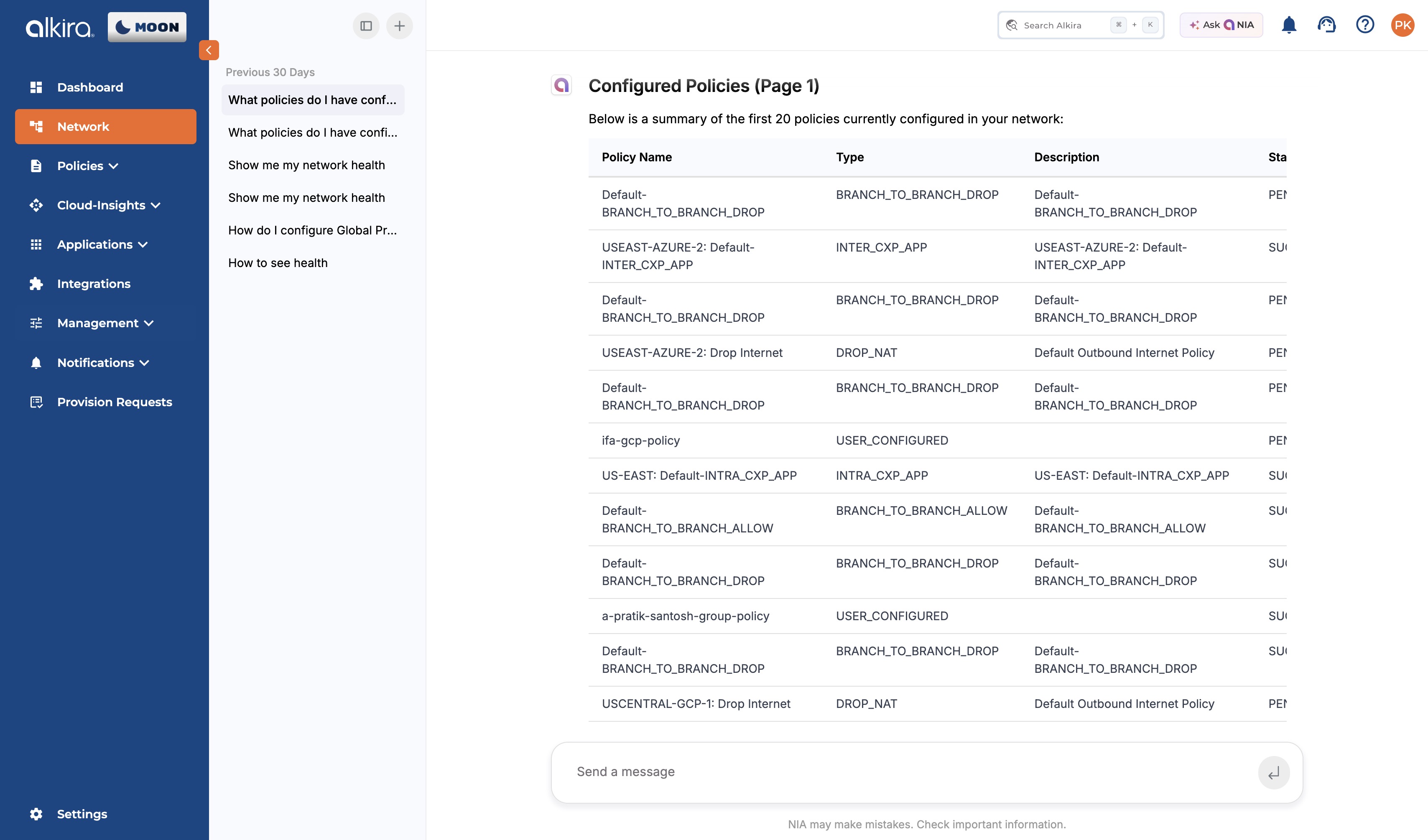
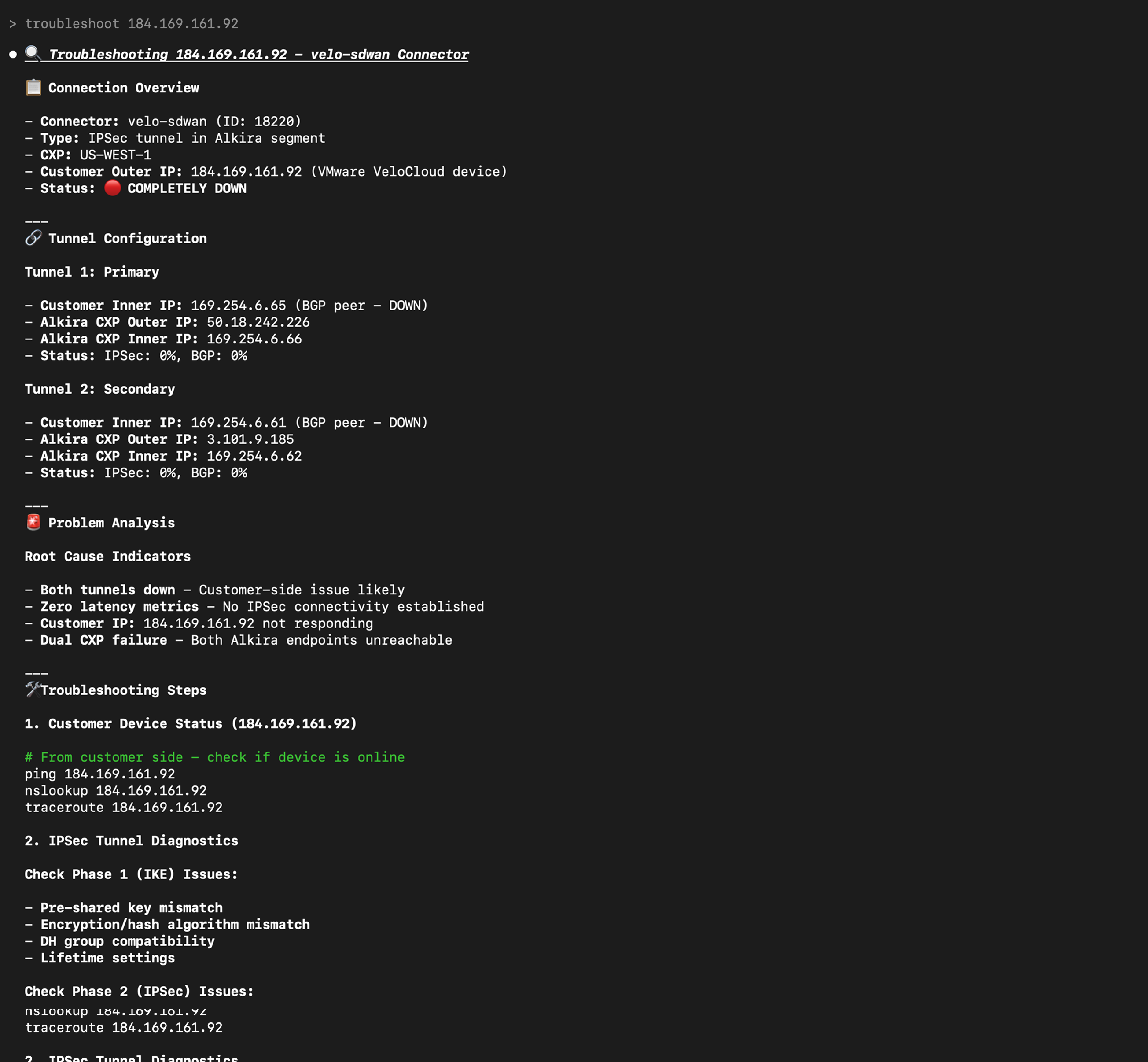
Beyond standalone tools, AI capabilities are embedded directly into product surfaces customers already use. NIA (Network Infrastructure Assistant) is the centerpiece: native to the portal, no setup required, full network context awareness.
NIA · launched Q2 2026 · native to the portal
01
Error Summarization
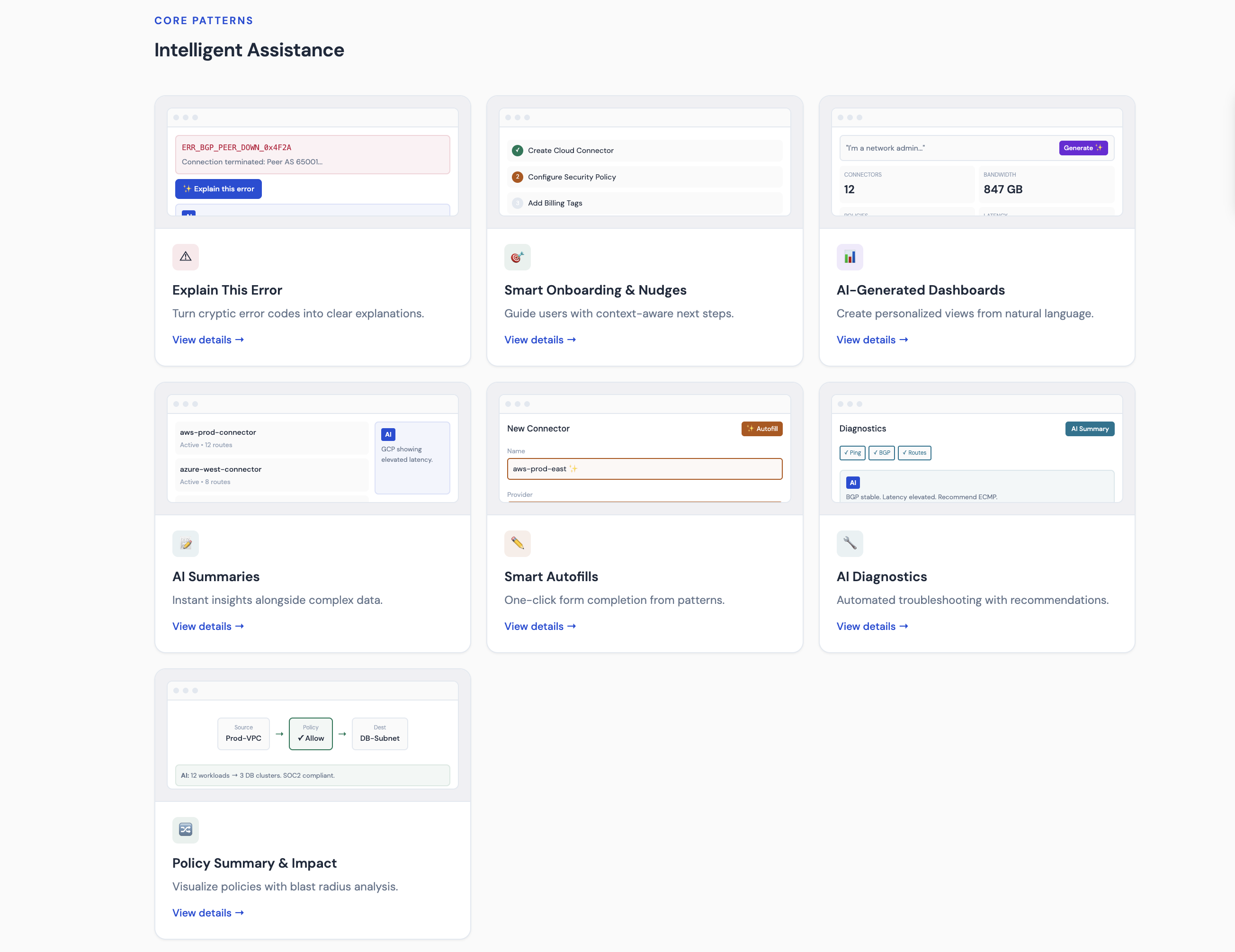
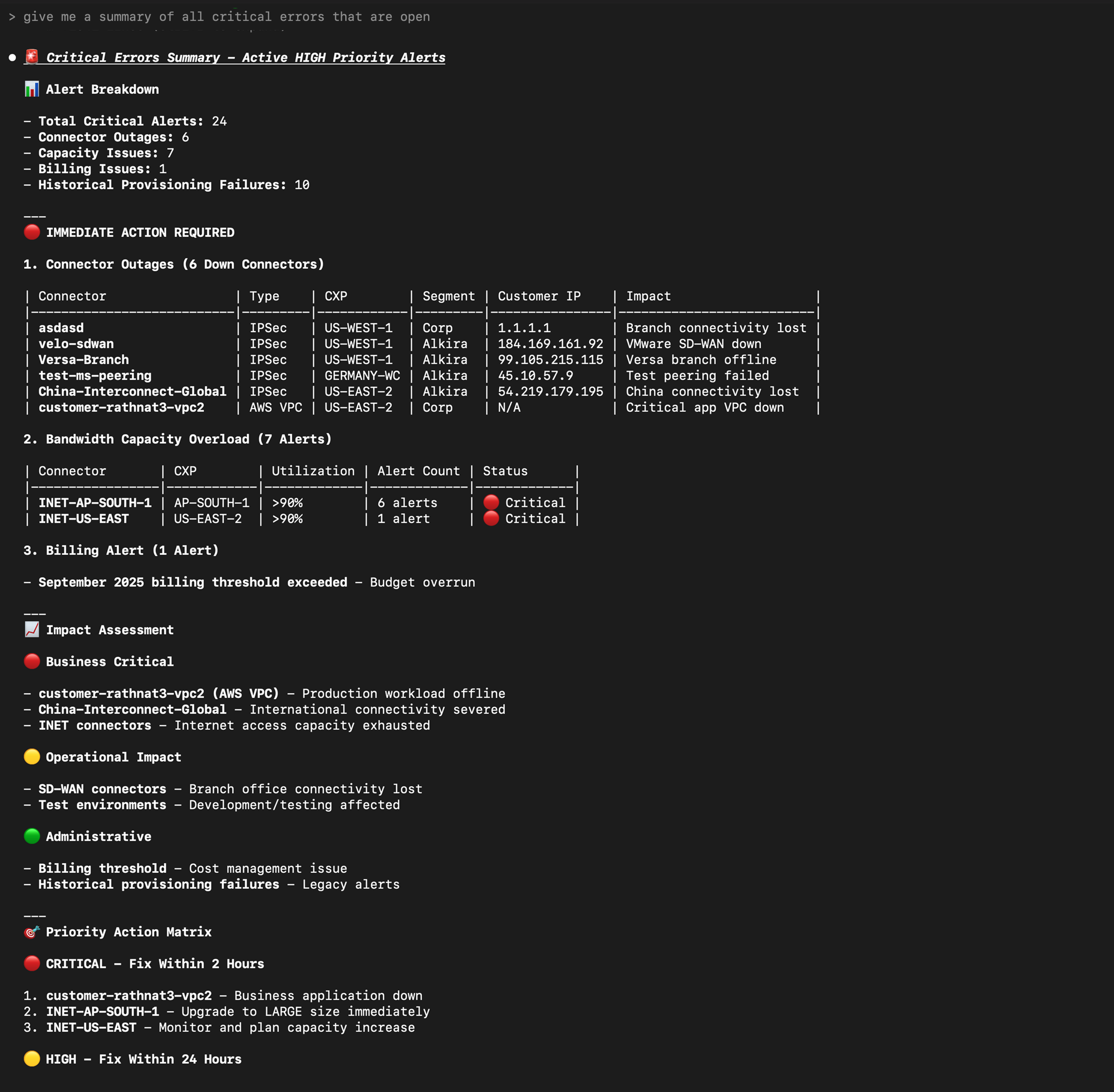
Turns cryptic error codes into plain-language explanations with next steps. No more decoding hex at 2 AM.
02
Provision Summarization
Multi-step provisioning distilled into status updates with context. Engineers see what matters, not every step.
03
AI UX Patterns
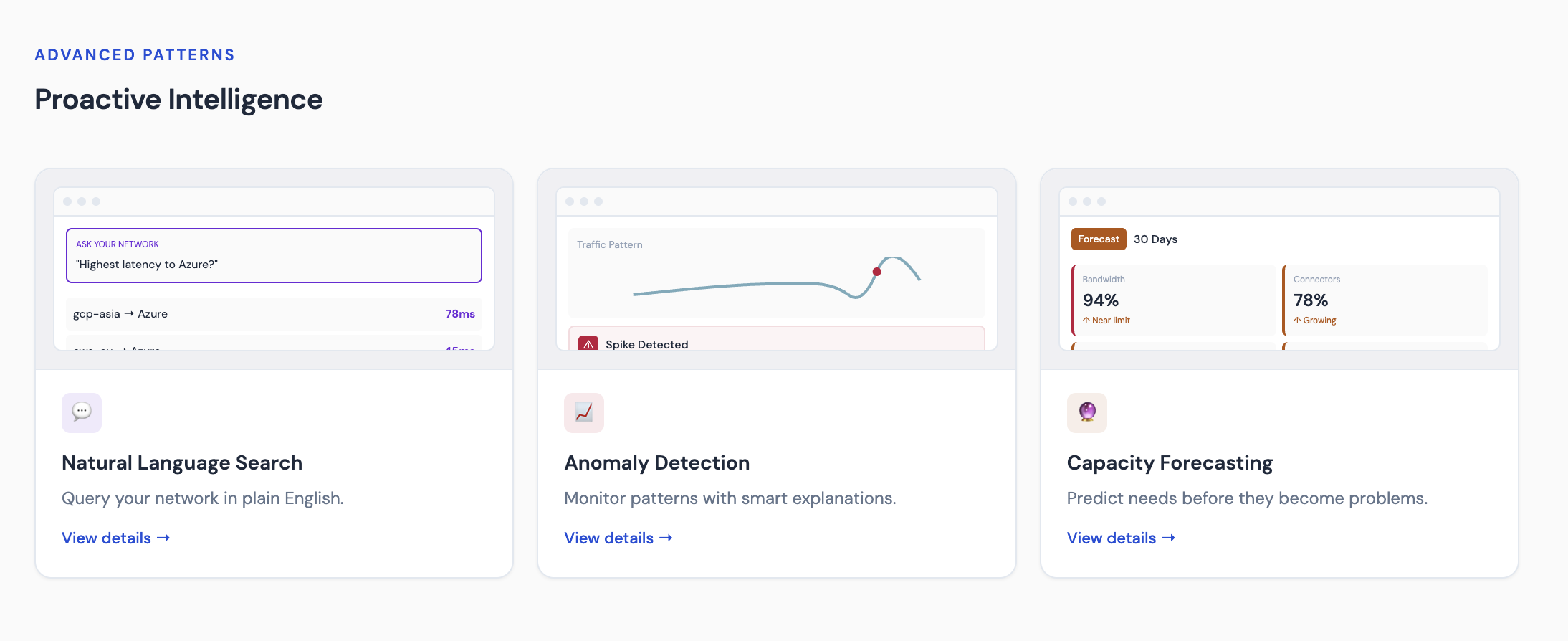
10 patterns designed in the Design Lab, informing product roadmap. From core to advanced, a complete AI UX vocabulary.
07 / PIPELINEThe UX pipeline
From error ticket to shipping fix.
MY ROLEBuilt this pipeline from scratch: 24 tools across 5 stages, one designer. Every stage feeds into AI Generate. That's the multiplier.
The hardest part wasn't designing any single AI feature. It was designing a pipeline where the feedback loop was shorter than the bug's half-life. Support saw errors in real time; docs answered them; engineering fixed them; design polished the edges. AI sat at the seams, compressing hand-offs into minutes.
01
Freshdesk
Support tickets analyzed, error patterns clustered by severity and frequency
02
Coralogix + Heap
Session replays and interaction analytics layered to build user context
03
AI Synthesis
All signals synthesized, problem areas surfaced with severity ranking
04
Jira
Validated against current sprint, cross-referenced with backlog and priorities
05
Codebase
Requirements created from local codebase and API data, error ticket prioritized
06
Claude Code
Implementation built: spec to code, tested, and packaged for handoff
07
Figma + Co-pilots
Design created with AI co-pilots, prototypes generated and iterated
08
Ship
Testing plan created, ready to go out. Full loop from ticket to fix.
08 / DESIGN LABCross-functional impact
Six teams, six projects, one framework.
MY ROLEInitiated, scoped, and led all six Design Lab projects across engineering, sales, platform, support, design, and product teams.
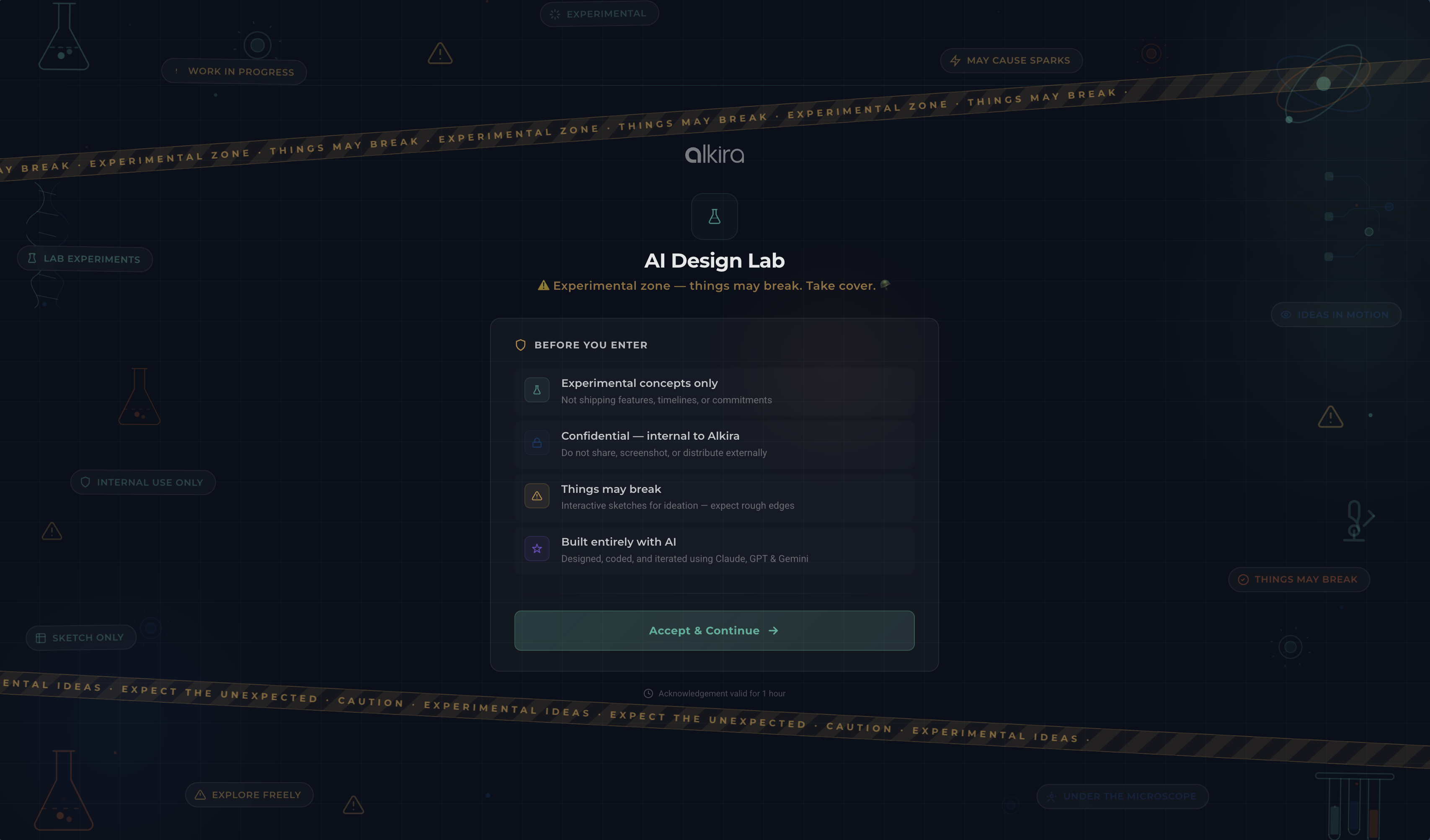
Cross-functional collaboration powered by AI. Each project proved the framework with a different team. Each one had its own AI/human ratio, tracked honestly.
AI Design Lab Walkthrough
WATCH DEMO
ENG
DevOps Dashboard
Telemetry visibility and uptime monitoring. 70% AI / 30% Human
SALES
Sales Calculator
Cost estimation for SEs and solution architects. 60% AI / 40% Human
PLATFORM
Object Dependency Map
Find connections and gaps across the system. 75% AI / 25% Human
SUPPORT
Support Analysis
Ticket clustering and trend analysis for product. 85% AI / 15% Human
DESIGN
AI Design Pipeline
Prototype generation, spec automation, handoff. 90% AI / 10% Human
PRODUCT
Mobile App
Customer-facing mobile for network management. 50% AI / 50% Human
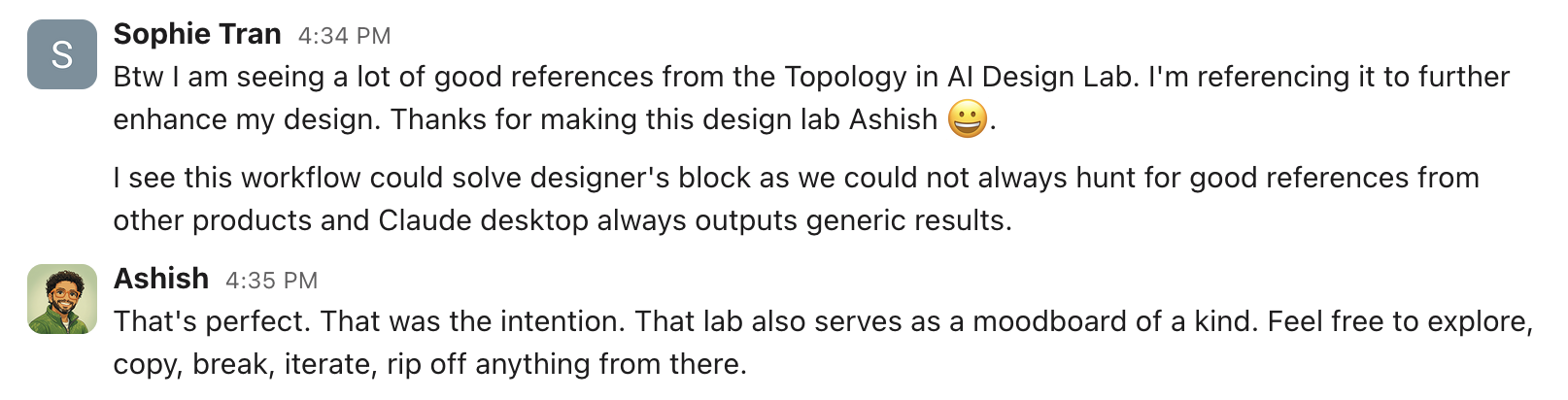
Sophie Tran · Senior Designer
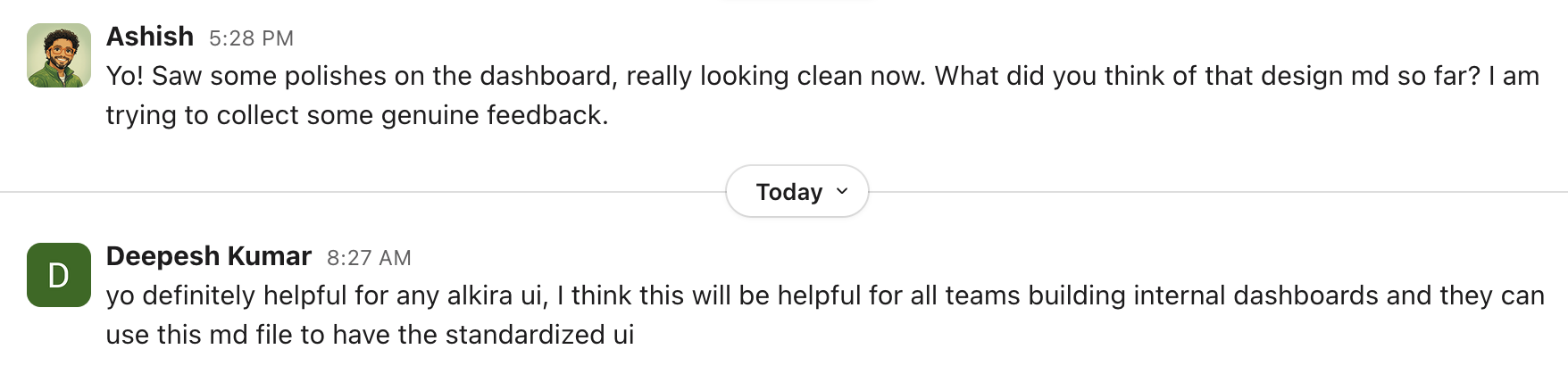
Deepesh Kumar · Sales Engineering
UNPROMPTED SLACK FEEDBACK · CROSS-FUNCTIONAL VALIDATION
09 / GOVERNANCEThe honesty matrix
Knowing where not to use AI is part of the skill.
MY ROLECreated the governance framework, defined red lines, and enforced them across all six Design Lab projects.
Every framework needed its red lines. Irreversible operations, compliance-bound configurations, customer-facing status of record: these were never up for autonomous action. Trust is an asset that takes years to build and one bad recommendation to burn.
AI EXCELS AT
- Scaffolding and component generation
- Data visualization templates
- Ticket clustering and theme extraction
- Prototype-to-code translation
- Spec and doc automation
80% VOLUME
HUMANS OWN
- Architecture and system thinking
- Empathy-based prioritization
- Brand voice and creative direction
- Interaction design taste and finesse
- Design system governance
80% VALUE
Amplify and get amplified. The goal isn't replacement. It's making every person 10x more capable.
10 / AI ADVANTAGEThe multiplier
How AI changed every stage.
MY ROLEMeasured before vs. after across 5 phases over the last 2 quarters. Every claim traceable to source.
The speed comes from the pipeline, not from cutting corners.
5x
Research
Days to hours. Manual to citation-backed.
10-15x
Design
1 concept to 3-5 variants. Co-pilots accelerate exploration.
10x
Code
5-10 days to hours. Figma to Claude Code to ship.
4x
Testing
Manual QA to AI test plans. Edge cases auto-generated.
6
Collab
Teams enabled. Cross-functional adoption: Eng, Sales, Support, Product.
11 / TRAININGOrg-level impact
Training teams to work differently.
MY ROLEDesigned and delivered training programs for three departments, each tailored to their specific workflows and skill levels.
01
Marketing
Build their own pages, refresh assets, create campaigns without external agency dependency. Regular training sessions.
02
DevOps
Build internal dashboards, monitoring tools, and portals without external contractors. Hands-on workshops.
03
Product
Run their own research analyses, ticket clustering, competitive analysis without waiting for design. Quality bar enforcement.
Get beyond vibe coding. AI-assisted work without taste, domain knowledge, and craft is just expensive generation. Amplification, not replacement.
12 / MEASUREMENTWhat it moved
How do you measure AI impact at a startup?
MY ROLEBuilt the measurement framework: pragmatic, resource-aware, designed to scale with what we learn.
Not by vanity metrics. By how many decisions got easier, how many tickets closed themselves, how many designers shipped without waiting.
6
Teams on the framework
Design · Eng · PM · Support · Docs · Marketing
3
Departments trained
In AI-fluent practice · hands-on, role-specific
30
Roles brought in-house
Design practice grown from zero
6→1
Products, one system
Alkira DS 2.0 unifying the portfolio
IMPACT
Cycle time
Reduction in cycle time, roles consolidated, validation speed
INTEREST
Adoption
Cross-team adoption, unprompted usage, feature requests
REACH
Integrations
MCP external integrations, NIA sessions, departments enabled
QUALITY
Accuracy
Rework rate, AI output acceptance, human override frequency
The dashboard tracking all of this is itself an AI-built artifact. We use the framework to measure the framework. That's the startup loop.
13 / LESSONWhat it taught me
What building an AI practice taught me.
01
Frameworks scale. Features don't.
A framework survives the fourth re-org; a feature dies with its PM.
02
Design is a distribution problem.
The best idea that no team adopts is worse than the average idea six teams ship.
03
Training is product work.
The same care that goes into onboarding a customer goes into onboarding a colleague to a new tool.